
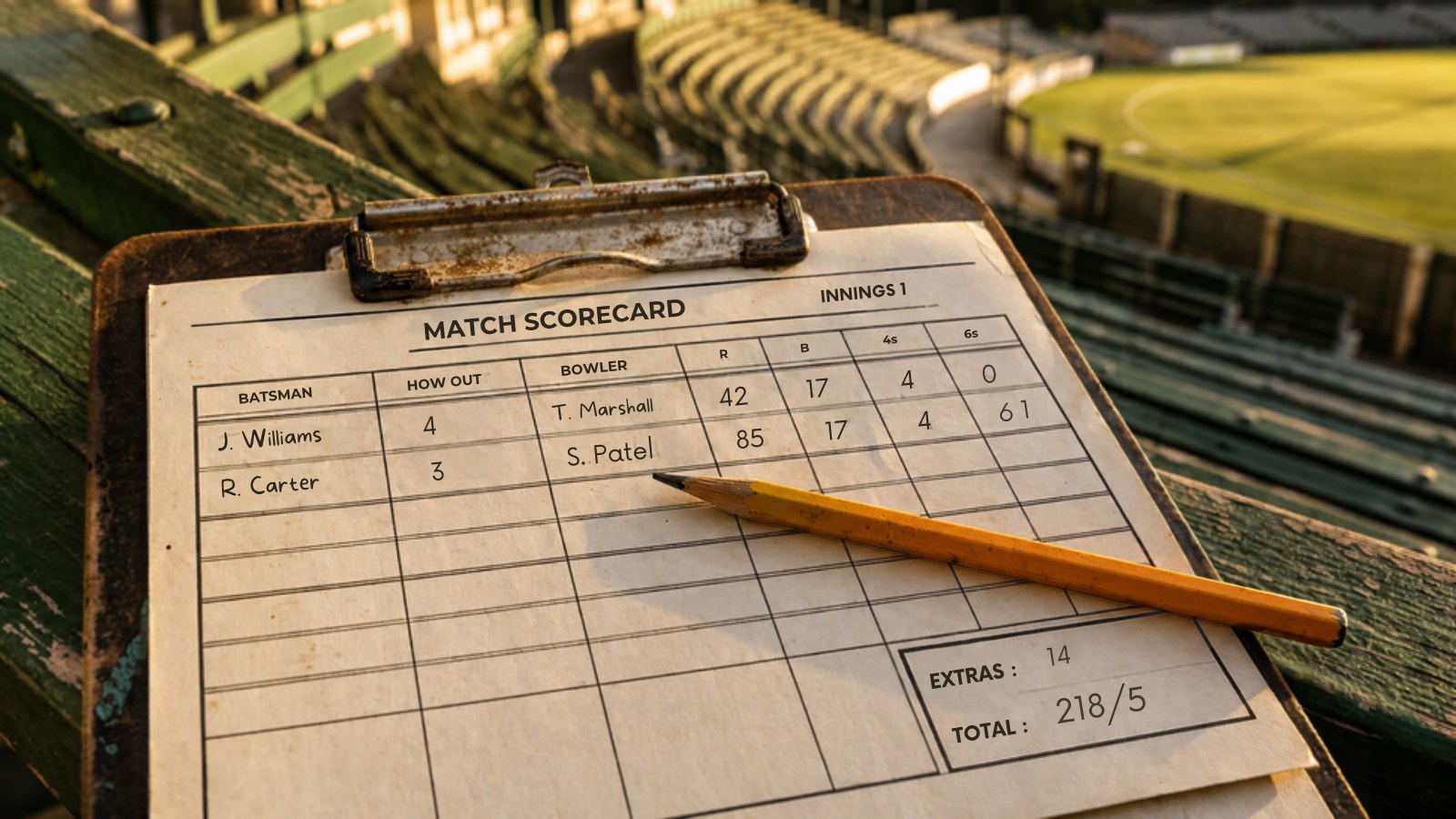
Here is a single line from a scorecard:
R Sharma c Buttler b Archer 46 (31) 5 1 148.38
By the end of this guide that line will read as a sentence rather than a code. Scorecards pack a whole innings into a shape that has barely changed in a century, and every column in them is doing a specific job.
Step 1: The Batting Table
The batting table lists players in the order they came to the crease. Each row carries the same seven pieces of information.
| Column | What it means |
|---|---|
| Batter | The player’s name, in batting order |
| Dismissal | How the innings ended, or “not out” |
| R | Runs scored |
| B | Balls faced |
| 4s | Boundaries hit along the ground |
| 6s | Boundaries hit over the rope |
| SR | Strike rate, runs per 100 balls |
So the line above says: R Sharma was caught by Buttler off Archer’s bowling, having scored 46 runs from 31 balls, including five fours and one six, at a strike rate of 148.38.
Strike rate is the only calculated column. It is runs divided by balls, multiplied by 100. A strike rate of 148.38 means that over a hundred balls, at that rate, the batter would score roughly 148 runs.
Step 2: Decoding the Dismissal
The dismissal column is the part that looks most like shorthand. There are only a handful of patterns.
| Notation | Meaning |
|---|---|
| b Archer | Bowled by Archer |
| c Buttler b Archer | Caught by Buttler, bowled by Archer |
| lbw b Archer | Leg before wicket to Archer |
| st Buttler b Leach | Stumped by the wicketkeeper off Leach |
| c and b Archer | Caught by the bowler off his own bowling |
| run out (Root) | Run out, with Root credited for the throw |
| not out | Still batting when the innings ended |
| retired hurt | Left the field injured, may return |
| absent hurt | Unable to bat at all |
The pattern to hold on to is that the fielder’s name comes first and the bowler’s name comes last. “c Buttler b Archer” always means Buttler caught it and Archer bowled it, never the reverse.
Run-outs are the exception. No bowler is credited, which is why a run-out never counts towards a bowler’s wickets or towards a hat-trick.
Step 3: Extras
Below the batters sits a line of extras. These are runs the batting side gained without a batter scoring them.
- b Byes. The ball beat everyone, including the keeper, and the batters ran.
- lb Leg byes. The ball hit the batter’s body, not the bat, and the batters ran.
- w Wides. The ball was too far from the batter to be played. One run, and the ball is bowled again.
- nb No-balls. An illegal delivery. One run, the ball is bowled again, and in limited-overs cricket the next ball is often a free hit.
- p Penalty runs. Awarded by the umpires, usually five at a time, for an offence in the field.
A line reading Extras (b 2, lb 5, w 8, nb 1) 16 tells you sixteen of the team’s runs came from these sources, eight of them from wayward bowling.
Step 4: The Total
The total line is the one most people read first.
183/5 (20 overs) means 183 runs for the loss of 5 wickets in 20 overs. Australian scorecards invert it and write 5/183, which means exactly the same thing.
111 all out (19.2 overs) means the innings ended early because all ten wickets fell. The 19.2 means nineteen overs and two balls, not nineteen and a fifth. Each over has six balls, so the decimal in an over count runs from .1 to .5.
Run rate usually appears beside the total. It is runs divided by overs, so 183 in 20 overs is a run rate of 9.15.
Step 5: Bowling Figures
The bowling table uses five columns.
| Column | What it means |
|---|---|
| O | Overs bowled |
| M | Maidens, overs from which no runs were scored |
| R | Runs conceded |
| W | Wickets taken |
| Econ | Economy rate, runs conceded per over |
Figures of 4-0-23-2 read as four overs, no maidens, twenty-three runs conceded, two wickets taken, an economy of 5.75.
When someone says a bowler took “four for twenty”, they are reading the last two columns and ignoring the first two. Written out in full it is wickets first in speech and wickets second in the table, which trips people up more often than it should.
Step 6: Fall of Wickets
Under the batting table runs a line that looks like this:
1-39 (Sharma, 4.2), 2-56 (Gill, 7.1), 3-121 (Kohli, 14.4)
Each entry gives three things: which wicket it was, the team total when it fell, and who was out with the over in which it happened.
So the second wicket fell with the score on 56, Gill was the batter, and it happened on the first ball of the eighth over.
This line is the quickest way to find the shape of an innings. Three wickets inside the first eight overs tells a different story from three wickets in the last two, even when the final total is identical.
Step 7: Reading a Live Scoreline
During a match the scoreline compresses all of this into a few characters.
IND 128/3 (15.0 ov) | CRR 8.53 | RRR 11.00
- 128/3 is the current total and wickets.
- (15.0 ov) is how far through the innings the side is.
- CRR is the current run rate, what they have been scoring at.
- RRR is the required run rate, what they now need to score at to win.
When RRR climbs above CRR and keeps climbing, the chase is slipping away. That one comparison carries more information about the state of a game than the raw score does.
Putting It Together
Take this fragment:
S Verma c Athapaththu b Ranaweera 68 (39) 9 2 174.35
Reading left to right: Verma was caught by Athapaththu off Ranaweera’s bowling. She made 68 from 39 balls with nine fours and two sixes, scoring at 174 runs per hundred balls.
And a bowling line from the same card:
S Charani 4-0-20-4
Four overs, no maidens, twenty runs, four wickets. An economy rate of 5.00 in a format where seven or eight is normal, with four wickets attached to it.
Neither line needs a commentator to explain it once the columns are familiar. That is the whole point of the format: an innings nobody watched can still be reconstructed, ball order and all, from a single page.